By Akshata Amara & Dhriti Kamani
Summary
UPI turned India into a country where a chai stall and a billion-dollar bank run on the same rails. Born in 2016, it survived demonetization, exploded during COVID, and now processes more transactions than Visa, at nearly zero cost, with 99.99% uptime. From Paris to a button phone in rural India, it's proof that smart policy can beat billions in venture capital.
How India adopted UPI
Let’s take a step back to the morning of November 9th, 2016. That was the day every ₹500 and ₹1,000 note in your wallet became worthless paper overnight. Back then this accounted for 86% of India's currency. Our daily transactions with shop vendors, auto drivers and the like screeched to a halt. Cash which drove over 1.4 billion transactions daily was now missing in action.
But six months earlier, a quiet team at the National Payments Corporation of India (NPCI) had launched something: the Unified Payments Interface (UPI). A digital payment network that let anyone with a phone number send money instantly, with a single digital address like name@bankname. No KYC, no cards, no digital wallets.
When demonetization hit, UPI wasn't a convenience anymore. It was oxygen.
Transactions jumped by 11× month-by-month. Chai vendors who'd never owned a card reader suddenly had QR codes taped to their stalls. Farmers paid laborers via missed calls on feature phones. Landlords collected rent through WhatsApp messages.
Then came March 2020: COVID-19 lockdowns. Cash became a contamination risk. The fear of touching banknotes pushed the last holdouts; small retailers, street vendors, elderly shopkeepers, to use UPI. Active users nearly doubled in a single year, from 14 crore to 22 crore. What started as a policy experiment in 2016 became the default way India moved money by 2021.
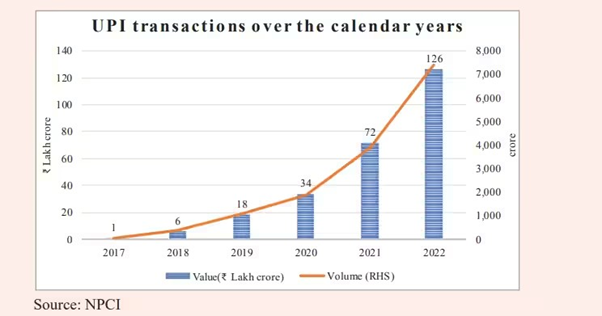 https://www.moneycontrol.com/news/business/economic-survey-2023-upi-accountedfor-52-of-indias-total-digital-transactions-in-fy22-9970741.html
Internationalization UPI
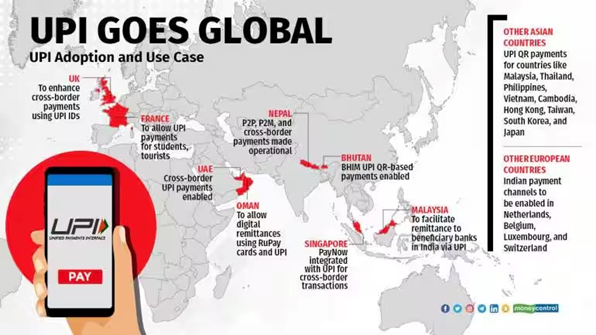
France became the first European country to adopt UPI in early 2024 through a partnership between NPCI International and France’s Lyra Group, enabling Indian tourists to pay in rupees at locations like the Eiffel Tower without currency conversion. In Singapore, a 2023 linkage between UPI and the local PayNow system allowed instant cross-border transfers and payments by mobile number between Indian and Singaporean users. The UAE integrated UPI across 60,000 outlets, including Lulu Hypermarkets and major malls, via collaborations between NPCI and local banks such as Mashreq. Bhutan and Nepal were among the earliest adopters, while Sri Lanka and Mauritius later enabled UPI QR payments to support tourism and remittances
This global journey is all about people: an Indian family dining at a Paris café, an NRI doctor shopping in Doha, a techie visiting Singapore , they all share a simple experience. They tap their UPI app, choose the merchant’s QR code, enter their PIN, and payment is done as if they never left home. Behind the scenes, NPCI signs MoUs with foreign banks and fintechs to build these bridges. But for the user it’s just as easy as sending money to a friend. In a way, UPI has made the world a bit smaller for India: one nationwide wallet now plays around the globe.

The brilliance of the UPI tech stack and surrounding policy
NPCI wasn't a tech startup chasing a crazy high valuation. They were government-paid scientists and engineers who combined RBI policy with open-source tech to build something Silicon Valley still can't replicate: a payment system that moves more than 18 Billion transactions a month, costs almost nothing to run, and works for everyone from CEOs to chai wallahs.
Here's how they did it and why it works;
Regulation Beats Capital Every Time
Google, Meta, and Amazon solve scale problems by spending billions on data centers and infrastructure. NPCI took a different route: they added one sentence to a Reserve Bank of India regulation.
| "Every licensed bank must make available a single, open API that talks UPI."
An API (Application Programming Interface) is just a standardized way for different software systems to connect and talk to each other. That single regulatory requirement meant every bank account in India; hundreds of millions of them; had to become accessible through UPI overnight. NPCI didn't need to sign partnership deals or convince banks one by one. The regulation did the work.

The lesson: when you align incentives correctly through policy, you inherit users, compliance, and trust without paying for any of it.
Apps That Talk to Each Other Win
In the West, payment apps are walled gardens. You can't send money from Venmo to Zelle; they simply don't connect. Each company hoards its users behind closed walls, hoping to build a competitive advantage.
UPI flipped this logic. It's a shared commons: 304 banks expose their payment APIs, and over 60 third-party apps (Google Pay, PhonePe, Paytm, and dozens more) compete on top of the same rails. Any app can send money to any bank account, instantly.
Paradoxically, removing the walls created the strongest advantage of all: network density. When everyone can reach everyone else, the whole system becomes impossible for any single company to replicate. It's like email; you don't need Gmail and Outlook to merge for messages to flow between them.
The Cost of Moving Money Approached Zero
UPI's cost per transaction is now less than $0.003; three hundredths of a cent. At that rate, processing 100 billion transactions a year costs almost nothing.
How? Traditional banks run on expensive legacy systems: Oracle's enterprise database software (costing millions in annual licensing), mainframes from the 1970s (massive IBM computers that need scarce COBOL programmers), and per-transaction licensing fees that charge you based on volume.
NPCI threw all of that out. They built the entire stack using free, open-source software:
- Kafka for messaging between systems
- Cassandra for storing data
- PostgreSQL for databases
- Kubernetes for managing servers
All of it runs on standard x86 processors; the same cheap hardware that powers most modern websites. No Oracle licenses. No mainframes. No fees that scale with transaction volume.
The entire codebase is Apache-licensed, meaning any country can download it, rebrand it, and launch their own national payment system in under a year.

Identity Is Verified Once Overall, Not Once Per App
In Western countries, you prove who you are repeatedly: enter your credit card for this app, verify your bank account for that service, upload ID documents somewhere else.
India solved this differently. Through Aadhaar, the government issued every resident a unique 12-digit biometric ID (verified by fingerprint or iris scan). UPI piggybacked on that identity system. Your KYC; Know Your Customer verification; happens once in your life, when you open a bank account. After that, every payment app can rely on the same verified identity.
This isn't just convenient; it's a massive cost savings. Building and maintaining identity verification systems is expensive. By reusing government infrastructure, UPI avoided rebuilding what already existed.
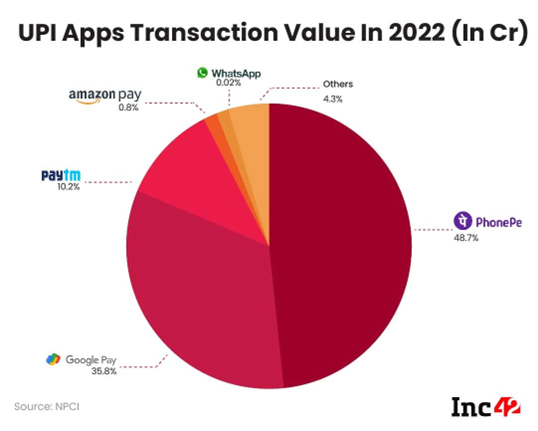
https://asset.inc42.com/2022/02/UPI-pie-chart_OYO_Charts_6-copy.jpg

Silence is the Goal, Not Headlines
When UPI has an outage, there's no viral "fail whale" meme, no angry Reddit threads trending worldwide. In April 2025, when the system went down, NPCI published a root-cause analysis PDF within 4 hours, fixed the issue in 5 hours, and released a detailed post-mortem within 24 hours.
That's it. No PR spin, no damage control press releases, no executive apologies on Twitter. Just a technical document explaining what broke and how they fixed it.
At this scale; handling more transactions than Visa; noise itself becomes a problem. The only acceptable communication is silence, interrupted occasionally by factual PDFs.
They Built for 10 Times The Anticipated Growth From Day One
In 2016, NPCI's original plan assumed they'd handle 10,000 transactions per second by 2020. Just to be safe, they designed the system to handle 100,000 transactions per second.
It seemed absurdly over-engineered at the time. But by 2025, UPI was sustaining 75,000 transactions per second during peak hours; and the system handled it without breaking a sweat. No emergency rewrites, no crisis meetings about splitting databases into smaller pieces, no "we need to re-architect everything" panic.
The lesson: if your design document doesn't look laughably over-provisioned on launch day, it's under-provisioned for year five.
Open Source Isn't Charity; It's Strategy
NPCI made the entire UPI codebase open source under an Apache license. Any central bank can clone it, customize it, and launch a national payment rail in less than a year.
Why give away the code for free? Because code isn't the competitive advantage. Network topology and regulatory alignment are.
If your edge is the software itself, you'll lose; someone will eventually build something better. But if your advantage is that every bank in the country must connect to your system by law, and millions of merchants already accept your QR codes, you can open-source everything and still win.
India doesn't sell payment software. It exports code repositories; and the countries that adopt them strengthen UPI's influence, not weaken it.
Sources & Citations
UPI Transaction Volumes & Growth:
- PIB: UPI Monthly Transactions (June 2025)- 18.4 billion transactions monthly
- PIB: UPI Statistics (December 2024)- 641 banks live on UPI
- PIB: UPI Apps Count (January 2025)- 80+ UPI apps active
Demonetization
Impact: https://www.researchgate.net/publication/389570067_Impact_of_demonetization_on_digital_payment_system
COVID-19 Pandemic Impact:
- Paytm Business: Growth of UPI Transactions- User base grew from 14 crore (March 2020) to 26 crore (March 2022); transactions valued at Rs 41 lakh crore during 2020-21
- Factly: Digital Transactions During Lockdown- Volume and value hit lowest point in April 2020, then recovered; April 2021 saw 94% more transactions than April 2020
- The Hindu Business Line: Covid Effect on UPI- UPI transactions increased significantly post-lockdown
- Economic Times: Digital Payments Surge- Nearly 76% of respondents were making digital payments as a result of COVID-19 pandemic Technical Infrastructure:
- Times of India: How NPCI Engineers Made UPI- Open-source stack (Cassandra, Java, commodity servers)
- Times of India: BHIM App Open Source- BHIM app open-sourced for banks
Cost & Operations: India Today: NPCI Profit & Transaction Costs (September 2024)- ₹500 crore for 213B transactions, 99.99% uptime
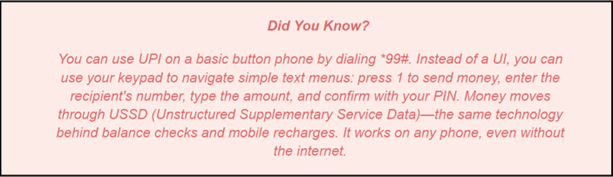
Button Phone Usage: MicroSave: UPI 123Pay & Feature Phones (October 2023)- 400M feature phone users exist; *99# transactions peaked at 2.44M in 2017, fell to 1.47M in 2022
Interoperability: Wikipedia: Unified Payments Interface- Cross-app/bank interoperability, April 2025 outage details